- A percentage is a fraction out of 100 -- the core formula is (Part ÷ Whole) × 100
- 4 calculation modes: % of, Is What %, % Change, and Change by %
- To find X% of Y: divide X by 100, then multiply by Y
- Percentage increase: ((New — Old) ÷ Old) × 100
- Stacked discounts multiply, not add -- 25% + 15% is 36.25% off, not 40%
- Mental math anchor: 10% is ÷10, 1% is ÷100, build any percentage from these
- The AFFLIGO calculator handles all 4 modes with instant results and formula display
- Always divide by the correct base -- the original value, not the new one
What Is a Percentage
The fundamental concept behind every percentage calculation -- fractions, decimals, and the 0-100 scale.
A percentage is a way of expressing a number as a fraction of 100. The word comes from the Latin "per centum" meaning "by the hundred." When you say 25%, you mean 25 out of 100, or 25/100, or 0.25.
Percentages are everywhere -- tax rates, discount signs, test scores, interest rates, battery indicators, progress bars. They provide a universal language for comparing proportions.
Fraction Form
25% = 25/100 = 1/4. Any percentage can be written as a fraction with 100 as the denominator. Simplify the fraction for easier mental math.
Decimal Form
25% = 0.25. To convert, divide by 100. To convert back, multiply by 100. This is the form used in calculations.
The 100 Scale
Percentages range from 0% (nothing) to 100% (everything). Values above 100% mean more than the whole -- e.g., 150% means 1.5 times the original.
Why 100?
The number 100 was chosen because we use a base-10 number system. It makes comparisons intuitive -- everyone understands what "50% off" means without needing to know the original price.
The formula (Part ÷ Whole) × 100 is the master equation for all percentage problems. Every question -- finding the part, finding the rate, finding the whole -- is just a rearrangement of this one formula.
The 3 Core Percentage Problems
Every percentage question falls into one of three categories -- master these and you can solve anything.
There are only three things you can calculate with percentages: finding the part, finding the rate, or finding the whole. Each has its own formula derived from the master equation.
Find the Part (What is X% of Y?)
Multiply the percentage (as a decimal) by the whole number.
- Formula: Part = (Percentage ÷ 100) × Whole
- Example: What is 20% of 150? — (20 ÷ 100) × 150 = 30
- Use case: Calculating tips, discounts, tax amounts
Find the Rate (X is what % of Y?)
Divide the part by the whole, then multiply by 100.
- Formula: Rate = (Part ÷ Whole) × 100
- Example: 45 is what % of 180? — (45 ÷ 180) × 100 = 25%
- Use case: Calculating grades, completion rates, market share
Find the Whole (X is Y% of what?) — manual method
Divide the part by the percentage (as a decimal). Note: the tool has no dedicated Whole mode — do this step by hand or use Tab 2 with trial values.
- Formula: Whole = Part ÷ (Percentage ÷ 100)
- Example: 30 is 20% of what? — 30 ÷ (20 ÷ 100) = 150
- Use case: Reverse calculations, finding original prices
| Problem | Formula | Example |
|---|---|---|
| Find the Part | (Percentage ÷ 100) × Whole | 20% of 150 = 30 |
| Find the Rate | (Part ÷ Whole) × 100 | 30 out of 150 = 20% |
| Find the Whole | Part ÷ (Percentage ÷ 100) | 30 is 20% of 150 |
AFFLIGO Percentage Calculator: 4 Modes
Four tabs cover every percentage question — pick the tab matching your question below.
The AFFLIGO Percentage Calculator covers all common percentage scenarios in a single tool. Each tab handles a different type of calculation with instant results and formula transparency.
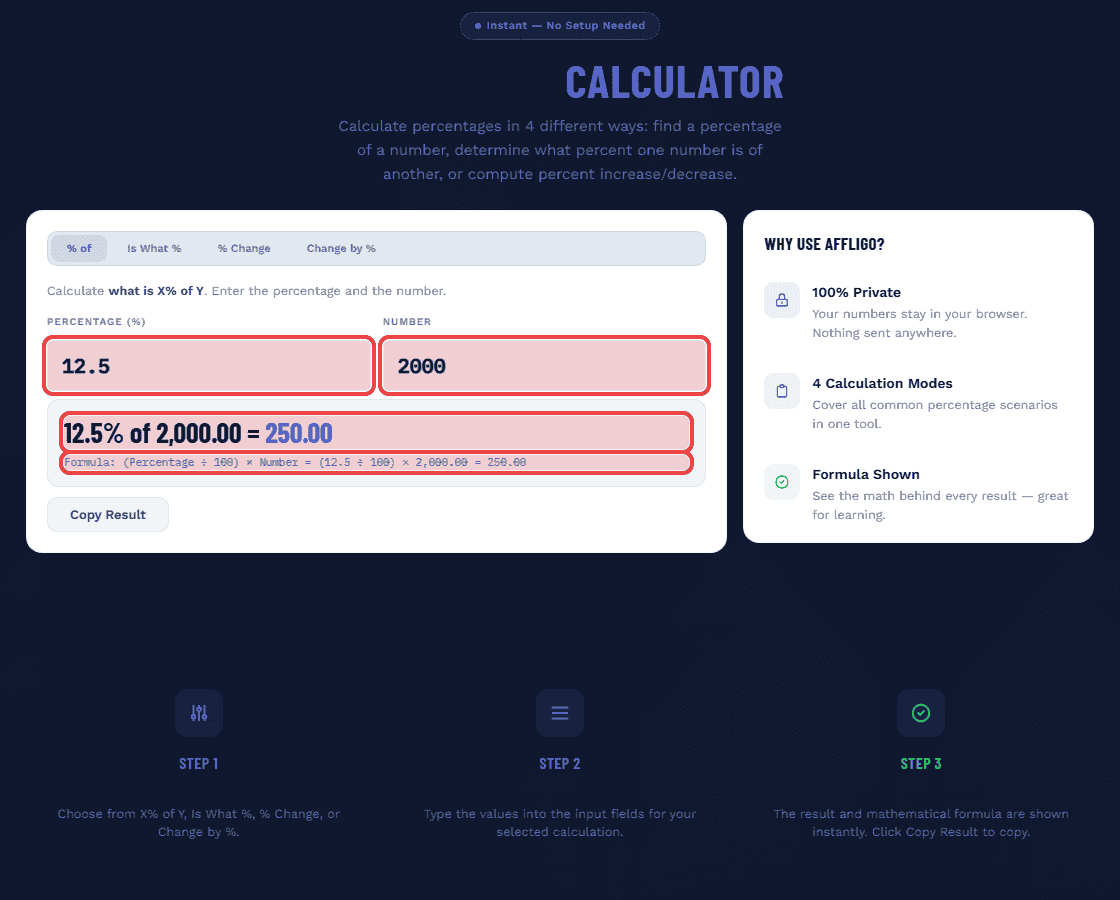
Tab 1: % of (Find the Part)
Enter a percentage and a number to find what that percentage equals.
- Question: What is 15% of 2000?
- Enter: 15 (percentage) and 2000 (number)
- Result: 300.00
- Formula shown: (15 ÷ 100) × 2000
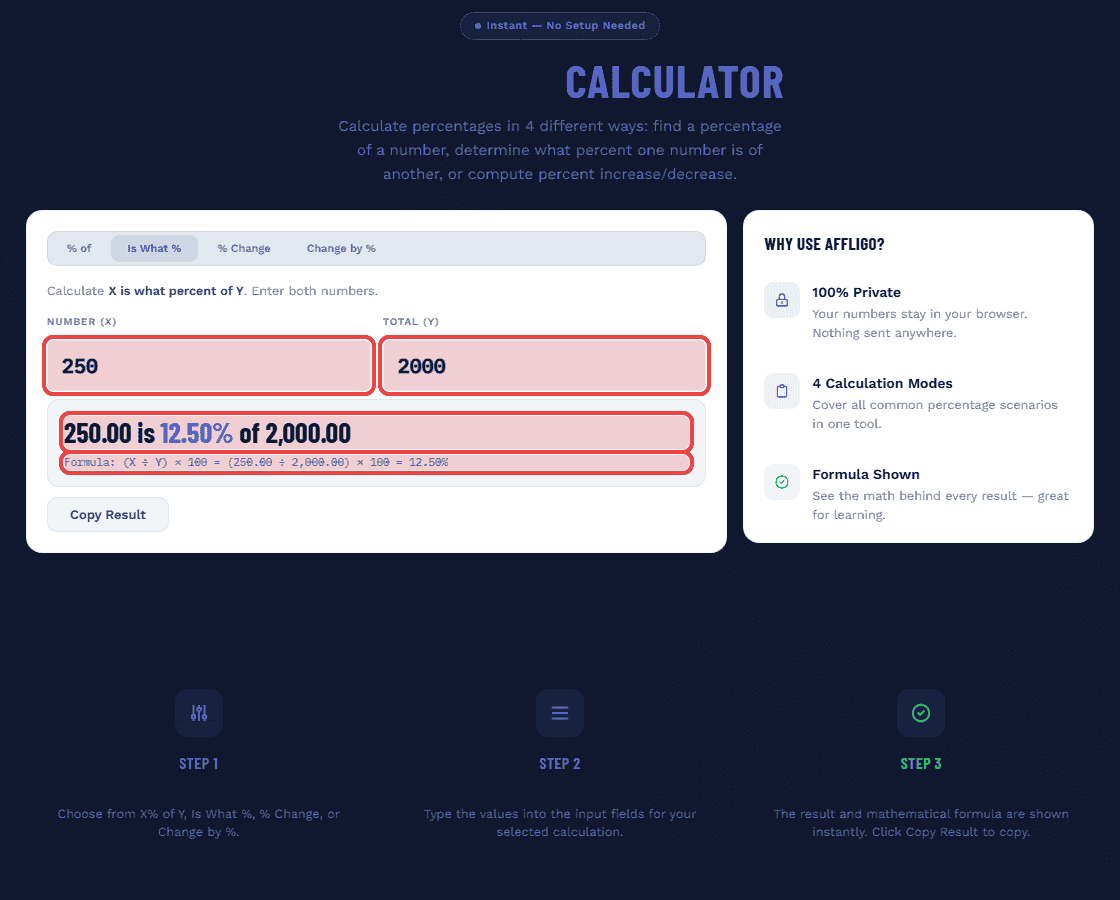
Tab 2: Is What % (Find the Rate)
Enter two numbers to find what percentage the first is of the second.
- Question: 250 is what % of 2000?
- Enter: 250 (part) and 2000 (total)
- Result: 12.50%
- Formula shown: (250 ÷ 2000) × 100
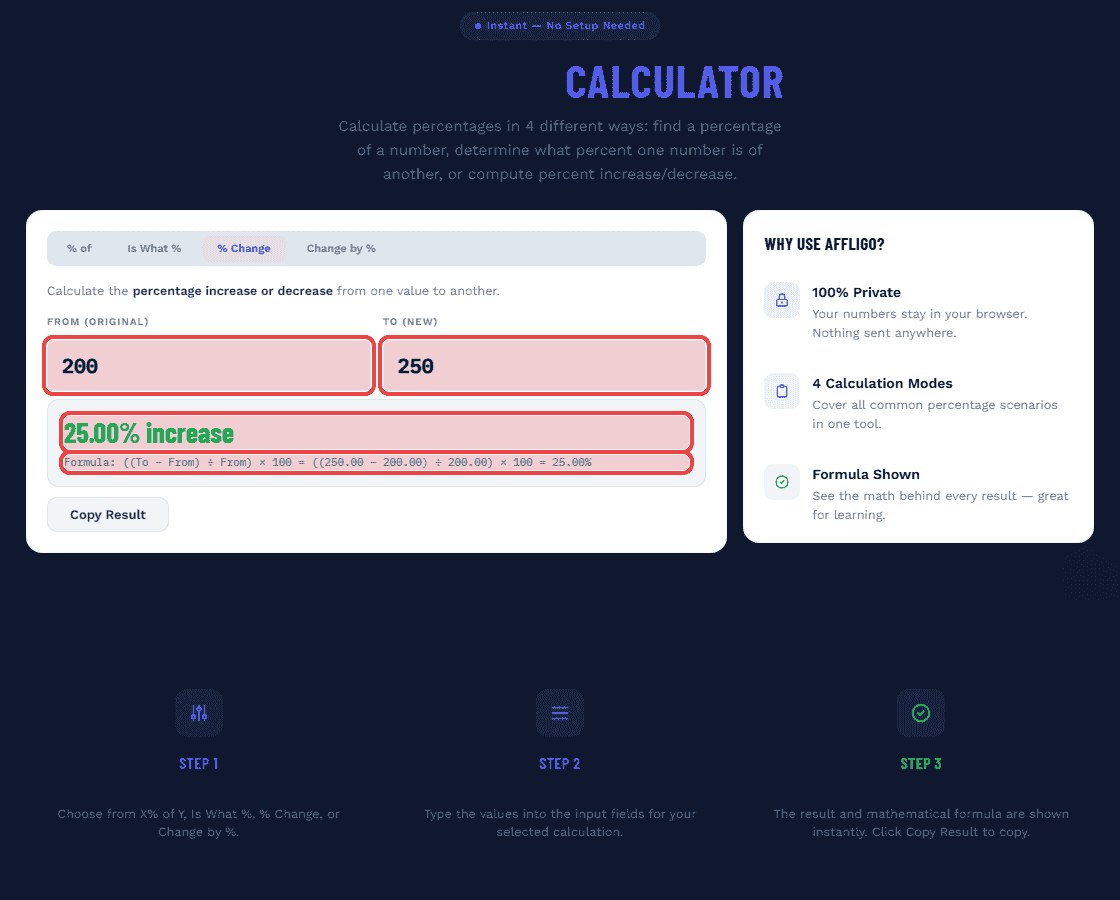
Tab 3: % Change (Measure Change)
Enter original and new values to find the percentage increase or decrease.
- Question: What is the % change from 200 to 250?
- Enter: 200 (original) and 250 (new)
- Result: +25.00% (increase shown in green)
- Formula shown: ((250 — 200) ÷ 200) × 100
Tab 4: Change by % (Apply a Percentage)
Enter a number and percentage to increase or decrease it by that amount.
- Question: Increase 2000 by 15%
- Enter: 2000 (number), select "Increase", 15 (percentage)
- Result: 2300.00
- Formula shown: 2000 × (1 + 15/100)
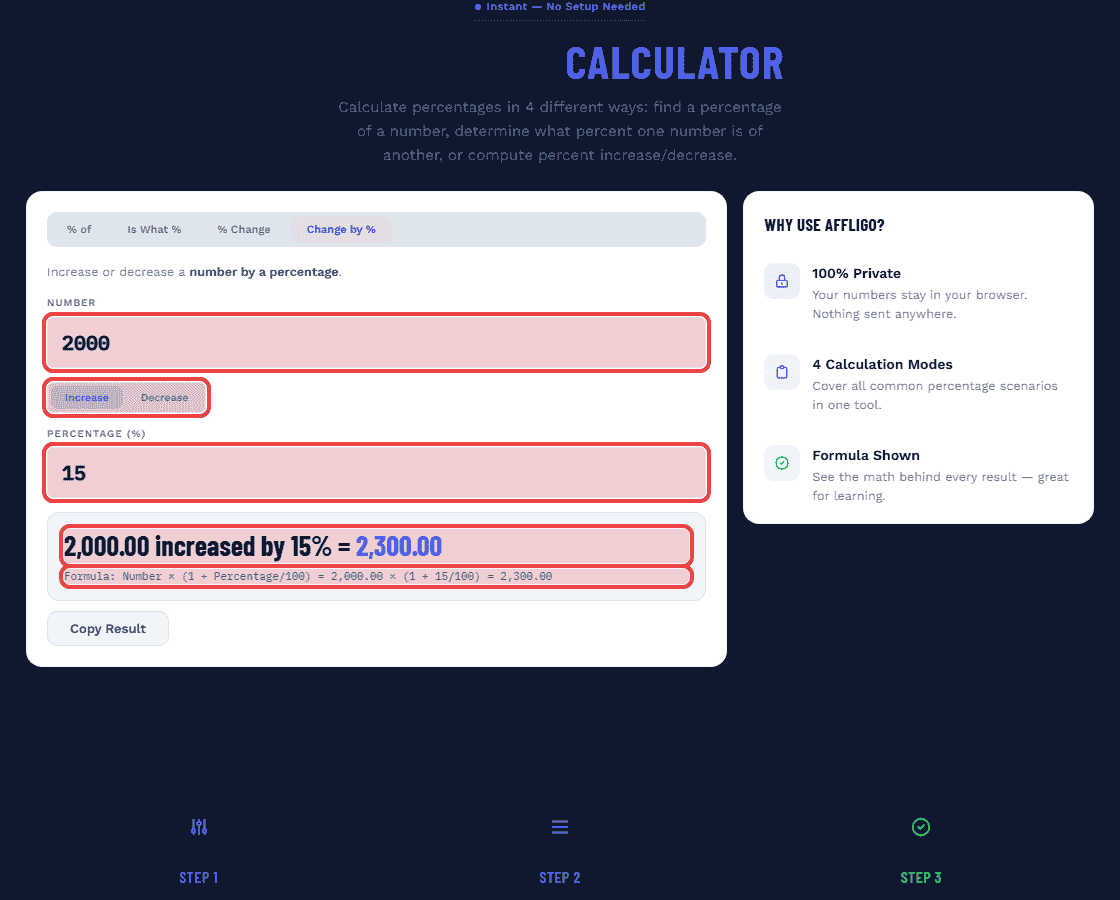
The calculator shows the formula below every result. This is great for learning -- you can see exactly how the math works. Use the Copy Result button to save any calculation to your clipboard.
What Is X% of Y? (Finding the Part)
The most common percentage question -- how to find a portion of any number.
When someone asks "what is 20% of 500?" they want to know what portion 20% represents. The answer is found by converting the percentage to a decimal and multiplying.
Convert Percentage to Decimal
Divide the percentage by 100. For example, 25% becomes 0.25. This is the multiplier.
Multiply by the Number
Multiply the decimal by the whole number. 0.25 × 800 = 200. That is 25% of 800.
| Question | Calculation | Answer |
|---|---|---|
| What is 10% of 500? | 0.10 × 500 | 50 |
| What is 15% of 200? | 0.15 × 200 | 30 |
| What is 25% of 800? | 0.25 × 800 | 200 |
| What is 30% of 1500? | 0.30 × 1500 | 450 |
| What is 5% of 12000? | 0.05 × 12000 | 600 |
| What is 12.5% of 480? | 0.125 × 480 | 60 |
Do not forget to divide by 100 first. Writing 25 × 500 instead of 0.25 × 500 gives you 12,500 instead of the correct answer: 125. Always convert to decimal first.
X Is What % of Y? (Finding the Rate)
Determine what percentage one number represents relative to another.
This question reverses the typical percentage problem. Instead of finding the part, you know the part and want to find the rate. Divide the part by the whole, then multiply by 100.
Divide Part by Whole
Take the smaller number and divide it by the larger number. For example, 30 ÷ 150 = 0.2.
Multiply by 100
Convert the decimal to a percentage by multiplying by 100. 0.2 × 100 = 20%. So 30 is 20% of 150.
| Question | Calculation | Answer |
|---|---|---|
| 45 is what % of 180? | (45 ÷ 180) × 100 | 25% |
| 3 is what % of 12? | (3 ÷ 12) × 100 | 25% |
| 72 is what % of 96? | (72 ÷ 96) × 100 | 75% |
| 150 is what % of 600? | (150 ÷ 600) × 100 | 25% |
| 12 is what % of 15? | (12 ÷ 15) × 100 | 80% |
| 500 is what % of 5000? | (500 ÷ 5000) × 100 | 10% |
Percentage Change: Increase & Decrease
How to measure the relative change between two values -- the formula that powers salary raises, price changes, and investment returns.
Percentage change tells you how much a value has increased or decreased relative to its starting point. This is different from absolute change (which is just the difference).
Subtract Old from New
Find the absolute difference: New — Old. If positive, it is an increase. If negative, it is a decrease.
Divide by the Original
Divide the difference by the original (old) value. This gives you the relative change as a decimal.
Multiply by 100
Convert to percentage: multiply by 100. The result tells you the percentage increase or decrease.
| Scenario | From | To | Calculation | Result |
|---|---|---|---|---|
| Salary raise | $50,000 | $57,500 | ((57500 — 50000) ÷ 50000) × 100 | +15% |
| Price drop | $200 | $150 | ((200 — 150) ÷ 200) × 100 | —25% |
| Investment gain | $10,000 | $12,500 | ((12500 — 10000) ÷ 10000) × 100 | +25% |
| Weight loss | 180 lbs | 162 lbs | ((180 — 162) ÷ 180) × 100 | —10% |
| Population growth | 500K | 625K | ((625000 — 500000) ÷ 500000) × 100 | +25% |
Always divide by the original (old) value, not the new one. If your salary goes from $50K to $57.5K, the increase is $7.5K. Dividing by $50K gives 15% (correct). Dividing by $57.5K gives 13% (wrong).
Increase/Decrease by X% (Applying Percent)
How to add or subtract a percentage from a number -- the calculation behind discounts, tax, and markups.
Sometimes you start with a number and want to increase or decrease it by a given percentage. This is the reverse of finding the percentage change.
To Increase by X%
Multiply the number by (1 + X/100). To increase 200 by 15%: 200 × 1.15 = 230.
To Decrease by X%
Multiply the number by (1 — X/100). To decrease 200 by 15%: 200 × 0.85 = 170.
Alternative: Find the Percentage, Then Add/Subtract
First find X% of the number, then add or subtract. 15% of 200 = 30. So 200 + 30 = 230 (increase) or 200 — 30 = 170 (decrease).
| Operation | Number | Percentage | Calculation | Result |
|---|---|---|---|---|
| Increase | $100 | 8% | $100 × 1.08 | $108 |
| Increase | $500 | 10% | $500 × 1.10 | $550 |
| Decrease | $200 | 25% | $200 × 0.75 | $150 |
| Decrease | $1000 | 15% | $1000 × 0.85 | $850 |
| Increase | 80 | 50% | 80 × 1.50 | 120 |
| Decrease | 400 | 10% | 400 × 0.90 | 360 |
Percentage Points vs Percent Change
The distinction that news headlines exploit -- and the one most people get wrong.
Percentage points measure the absolute difference between two percentages. Percent change measures the relative change. They are fundamentally different, but often confused.
Example: Interest Rates
Interest rates go from 4% to 6%. That is a 2 percentage point increase (6 — 4 = 2). But it is a 50% relative increase ((6 — 4) ÷ 4 × 100 = 50%).
Example: Test Scores
Your score goes from 60% to 72%. That is 12 percentage points higher. But you improved by 20% ((72 — 60) ÷ 60 × 100 = 20%).
When to Use Points
Use percentage points when describing absolute differences between rates: "The tax rate rose by 2 percentage points." Use percent change for relative comparisons.
Why It Matters
Headlines often say "interest rates doubled!" when they went from 2% to 4%. While technically a 100% increase, the absolute change is only 2 points. Both facts are true but tell different stories.
Reverse Percentages: Finding the Original
When you know the result and the percentage, how do you find the starting number?
Reverse percentage problems give you the final amount after a percentage change and ask you to find the original value. This is common with sale prices, tax-inclusive amounts, and post-increase values.
Identify the Multiplier
If the price was reduced by 20%, the multiplier is 0.80 (1 — 0.20). If it was increased by 15%, the multiplier is 1.15 (1 + 0.15).
Divide by the Multiplier
Divide the final amount by the multiplier. If something costs $120 after a 20% discount: $120 ÷ 0.80 = $150 (original price).
| Scenario | Given | Calculation | Original |
|---|---|---|---|
| Sale price after 30% off | $70 | $70 ÷ 0.70 | $100 |
| Price after 8% tax | $54 | $54 ÷ 1.08 | $50 |
| Salary after 10% raise | $55,000 | $55,000 ÷ 1.10 | $50,000 |
| Price after 15% discount | $85 | $85 ÷ 0.85 | $100 |
| Population after 20% growth | 600 | 600 ÷ 1.20 | 500 |
Stacked Discounts: Why 25% + 15% is not 40%
The math behind multiple discounts -- why successive percentages do not simply add up.
When a store offers "25% off, then an additional 15% off," the total discount is not 40%. Each discount applies to the already-reduced price, not the original. (For the classic 30% + 20% = 44% example, see the Discount Calculator guide.)
Apply First Discount
Start with $100. Apply 25% off: $100 × 0.75 = $75. The first discount reduces the price by $25.
Apply Second Discount
Now take 15% off $75: $75 × 0.85 = $63.75. The second discount only applies to the reduced price, saving you $11.25 (not $15).
Calculate Total Discount
You paid $63.75 for a $100 item. Total savings: $36.25, which is 36.25% off -- not 40%. The combined multiplier is 0.75 × 0.85 = 0.6375.
| Discount 1 | Discount 2 | Combined Multiplier | Total % Off |
|---|---|---|---|
| 10% | 10% | 0.90 × 0.90 = 0.81 | 19% off |
| 20% | 20% | 0.80 × 0.80 = 0.64 | 36% off |
| 30% | 20% | 0.70 × 0.80 = 0.56 | 44% off |
| 50% | 20% | 0.50 × 0.80 = 0.40 | 60% off |
| 25% | 15% | 0.75 × 0.85 = 0.6375 | 36.25% off |
For any two discounts A% and B%, the total discount is: 1 — (1 — A/100) × (1 — B/100). For 25% + 15%: 1 — (0.75 × 0.85) = 1 — 0.6375 = 0.3625 = 36.25% off.
Real-World Scenarios
Practical percentage calculations you use every day -- shopping, dining, grades, and taxes.
Shopping Discounts
40% off a $75 shirt: $75 × 0.60 = $45. You save $30. To find the discount percentage: ((75 — 45) ÷ 75) × 100 = 40%.
Restaurant Tips
18% tip on a $65 bill: $65 × 0.18 = $11.70. Total: $76.70. Quick way: 10% is $6.50, 20% is $13.00, so 18% is between those.
Exam Grades
42 correct out of 60 questions: (42 ÷ 60) × 100 = 70%. To get 80%, you need 48 correct answers (60 × 0.80 = 48).
Sales Tax
$200 item with 8.5% tax: $200 × 0.085 = $17. Total: $217. To find the pre-tax price from $217: $217 ÷ 1.085 = $200.
Salary Raise
$45,000 with a 12% raise: $45,000 × 1.12 = $50,400. The raise is $5,400. To negotiate a target salary: Target ÷ (1 + raise%) = current salary.
Weighted Grades
Exam 70% (score: 85), Homework 30% (score: 92): (85 × 0.70) + (92 × 0.30) = 59.5 + 27.6 = 87.1 weighted average.
Mental Math Tricks
Quick techniques to calculate percentages in your head -- no calculator needed.
The 10% Anchor
10% of any number is just that number divided by 10 (move the decimal one place left). 10% of 350 = 35. 10% of 80 = 8. This is your foundation for all other percentages.
The 1% Rule
1% of any number is that number divided by 100 (move the decimal two places left). 1% of 4500 = 45. 1% of 80 = 0.8. Build any percentage from 1% and 10%.
5% is Half of 10%
Find 10%, then halve it. 5% of 80: 10% = 8, half of 8 = 4. This works because 5% is exactly half of 10%.
25% is a Quarter
25% means "a quarter" -- divide by 4. 25% of 80 = 80 ÷ 4 = 20. For 75%, find 25% and subtract from the whole.
The Swap Trick
X% of Y = Y% of X. So 4% of 25 = 25% of 4 = 1. This works because multiplication is commutative: (4 × 25) ÷ 100 = (25 × 4) ÷ 100.
Combine Percentages
15% = 10% + 5%. Find 10% (÷10), find 5% (half of 10%), and add them. 15% of 60: 10% = 6, 5% = 3, total = 9.
Common Percentage Mistakes
Seven frequent errors that lead to wrong answers -- and how to avoid them.
Dividing by the Wrong Base
Always divide by the original value, not the new one. If a price goes from $80 to $100, the increase is 25% ($20 ÷ $80), not 20% ($20 ÷ $100).
Forgetting to Divide by 100
Writing 25 × 400 instead of 0.25 × 400 gives 10,000 instead of 100. Always convert percentage to decimal first.
Adding Percentages Directly
25% + 15% is not 40% off when applied sequentially. Successive discounts multiply: 0.75 × 0.85 = 0.6375, which is 36.25% off.
Confusing Points with Percent
A move from 4% to 6% interest is a 2 percentage point increase, but a 50% relative increase. These measure different things.
Assuming Percentages are Symmetric
A 50% increase followed by a 50% decrease does not return to the original. $100 — $150 — $75. The decrease is applied to the larger number.
Rounding Too Early
If you round 33.333% to 33% early in a multi-step calculation, errors compound. Keep decimals until the final answer.
Using Percentage Points When You Mean Percent
Saying "unemployment fell by 1%" when it fell from 5% to 4% is ambiguous. Say "1 percentage point" for the absolute change, or "20%" for the relative change.
While preparing this guide I ran all four calculator modes against hand math: 12.5% of 2000 = 250, 250 as % of 2000 = 12.5%, 200→250 = 25% increase, and 2000 + 15% = 2300. All four matched exactly, including the stacked-discount check (25% then 15% = 36.25% effective, not 40%).
Percentage in Business
How percentages drive business metrics -- profit margins, ROI, conversion rates, and growth.
Profit Margin
Formula: ((Revenue — Cost) ÷ Revenue) × 100. A product selling for $150 that costs $100 has a 33.3% profit margin. Higher margins mean more profit per dollar of revenue.
ROI (Return on Investment)
Formula: ((Gain — Cost) ÷ Cost) × 100. Invest $5,000, get back $6,500. ROI = ((6500 — 5000) ÷ 5000) × 100 = 30%.
Conversion Rate
Formula: (Conversions ÷ Total Visitors) × 100. If 30 out of 1,000 visitors buy, your conversion rate is 3%. Improving from 2% to 3% is a 50% relative increase in sales.
Growth Rate
Formula: ((Current — Previous) ÷ Previous) × 100. Revenue grew from $200K to $260K: ((260 — 200) ÷ 200) × 100 = 30% growth.
Market Share
Formula: (Your Sales ÷ Total Market Sales) × 100. If you sell $2M in a $20M market, your market share is 10%.
Markup vs Margin
Markup: ((Price — Cost) ÷ Cost) × 100. Margin: ((Price — Cost) ÷ Price) × 100. A $100 product that costs $60 has 66.7% markup but 40% margin.
Percentage in Finance
Interest rates, inflation, investment returns, and loan calculations -- percentages that affect your money.
Compound Interest
$10,000 at 5% annual compound interest: Year 1 = $10,500, Year 2 = $11,025, Year 3 = $11,576.25. Each year earns interest on the previous year's total.
Inflation
If inflation is 3%, something costing $100 today will cost $103 next year. Your purchasing power decreases by 3% unless your income grows at least 3%.
Loan Interest
A $200,000 loan at 6% annual interest costs $12,000 in interest the first year. Most early payments go toward interest, not principal.
Investment Returns
A 7% annual return doubles your money in about 10.3 years (Rule of 72: 72 ÷ 7 = 10.3). A 10% return doubles in 7.2 years.
To estimate how long it takes to double your money, divide 72 by the annual interest rate. 72 ÷ 6% = 12 years. 72 ÷ 8% = 9 years. This approximation works best for rates between 2% and 14%.
Tools Comparison
How the AFFLIGO percentage calculator compares to other options.
| Feature | AFFLIGO | calculator.net | Symbolab | Manual Formula |
|---|---|---|---|---|
| 4 Calculation Modes | Yes | Separate calculators | Limited | You do the math |
| Formula Display | Yes (every result) | No | Yes | N/A |
| Instant Results | As you type | On button click | On button click | N/A |
| Decimal Support | Yes | Yes | Yes | Yes |
| Privacy | 100% client-side | Server-side | Server-side | 100% private |
| Free | Yes, unlimited | Yes | Freemium | Free |
| Copy Result | Yes | No | No | N/A |
FAQ
Answers to the most common questions about percentage calculations.
Want to explore more?
Key Takeaways
- The master formula is (Part ÷ Whole) × 100 -- every percentage problem is a rearrangement of this.
- Always divide by the original value, not the new one, when calculating percentage change.
- Stacked discounts multiply, not add -- 25% + 15% is 36.25% off, not 40%.
- Use the 10% anchor for mental math: find 10% (÷10), then scale up or down for any percentage.